Why Your Screen Lanai Needs More Than a Quick Rinse
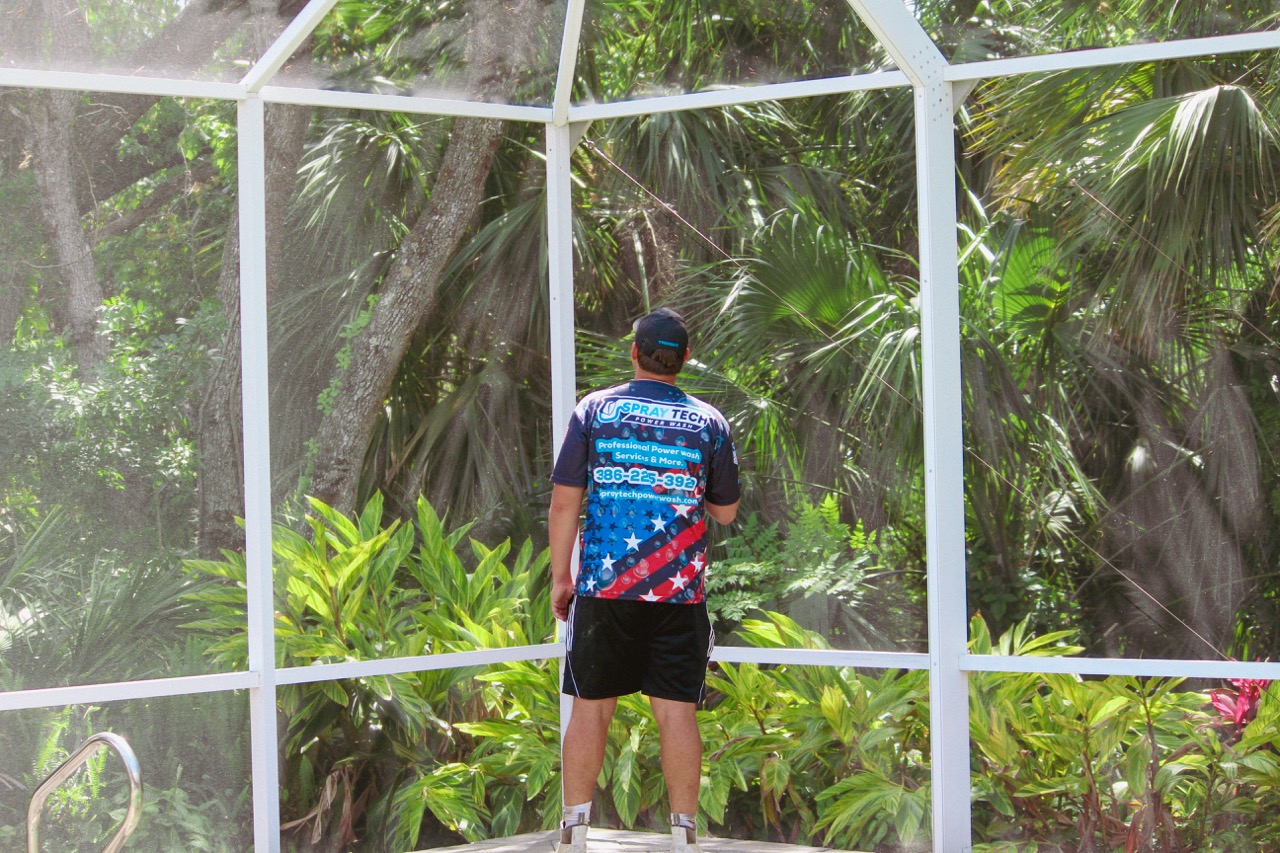
A screen lanai looks clean from the couch. Step outside and look closer, and you will usually find a different story: a haze building up on the screen mesh, spider webs tucked into the frame corners, and a dark film creeping across the lower panels where sprinklers hit most days. None of that shows up from six feet away, which is exactly why it tends to get ignored until the whole enclosure looks dingy.
What Actually Builds Up on a Lanai
Florida lanais collect more than dust. Pollen coats the screen heavily during spring pollen season, when oak and pine pollen settle into the mesh and turn it a dull yellow-green almost overnight. Spider webs accumulate in the frame joints and corners year round, since the humidity and steady bug supply give spiders little reason to move on. Shaded or low-airflow sections, especially corners tucked behind landscaping or under a roofline, develop mildew that darkens the mesh over time because Florida humidity rarely lets those spots fully dry out between rains.
Add in sprinkler overspray on the lower panels, which leaves mineral deposits and a hard water film that builds layer by layer with every irrigation cycle, and salt air if you are anywhere near the coast, which accelerates corrosion on aluminum framing and hardware, and a lanai that looked fine in January can look tired by July. Florida's rainy season from June through September makes this worse rather than better. Frequent rain keeps screens damp longer, which gives mildew and algae more time to take hold instead of washing anything away.
Why It Matters Beyond Appearance
A grimy screen does more than look dull. Buildup on the mesh blocks airflow and dims natural light, which makes an enclosed patio feel more closed-in than it should, especially during the months when the lanai should be the most usable part of the house. It can also make staining on frames and tracks harder to reverse the longer it sits, since some deposits set into the aluminum and screen fibers the longer they are left alone. Mineral deposits from sprinklers, in particular, bond more tightly to screen fiber the longer they bake in Florida sun between waterings. Mildew works the same way, since what wipes off easily after a few weeks can require real effort to remove after a full season of humidity has let it dig in.
Why This Is Not a Job for a Regular Pressure Washer
Screen mesh and lightweight aluminum framing do not hold up to the pressure that works fine on a driveway. Too much force can tear screens, bend framing, or force water into places it should not go, like light fixtures, outlets, or door tracks nearby. Screen mesh in particular has almost no margin for error. A pressure setting that barely dents dirt on concrete can blow a hole straight through the weave or stretch it out of shape, and a stretched screen never looks right again no matter how clean it gets. That is why a screen lanai cleaning uses a lower-pressure, solution-based approach built for the material, not a scaled-down version of a driveway clean.
What a Proper Cleaning Actually Does
We remove webs and loose debris first, working corners and frame joints by hand where buildup tends to hide. Then we apply a cleaning solution suited to what is actually on the screens and frames, since mildew, pollen film, or sprinkler mineral deposits are not all treated the same way and using the wrong approach on the wrong buildup wastes time without lifting the stain. The rinse stays low pressure throughout, and we take care around doors, outlets, and light fixtures rather than treating the whole enclosure as one uniform surface. Lower panels that catch sprinkler overspray usually need more attention than upper panels that only deal with pollen and dust, so we do not treat every section of the same lanai identically either.
What Cleaning Will Not Fix
Worth being direct here. Cleaning brightens screens and frames, but it will not repair torn mesh, fix a sagging panel, or reverse rust that has already pitted a frame. Salt air exposure near the coast can pit and corrode aluminum hardware over the years, and no amount of cleaning solution reverses corrosion that has already eaten into the metal. If we spot any of that during a job, we will point it out rather than clean around it and say nothing, since a customer deciding whether a panel needs repair or replacement deserves that information up front rather than a lanai that looks clean today and fails the same way again next season.
Get Your Lanai Looked At
SprayTech Power Wash cleans screen lanais and enclosures for homeowners across Palm Coast, Flagler Beach, St. Augustine, and Ormond Beach, working around the pollen season, rainy season, and coastal salt air that make Florida lanais dirty faster than most. Request a free quote to get your enclosure looked at. A portion of every job goes straight to the U.S. National Blind Soccer Team.